
Three Key Trends in the Hospital Labor Market in 2022
The COVID-19 pandemic has persisted for nearly two years, and the hospital labor market remains deeply troubled: staffing shortages and burnout are worsening, turnover rates remain high, travel nurse pay has surged, and union actions are frequent. This article outlines three major labor trends hospitals need to watch in 2022, citing data from agencies such as HHS, BLS, and S&P Global Ratings, as well as industry expert insights, to provide decision-making references for hospital administrators.
The COVID-19 pandemic has thrown the healthcare labor market into chaos, and it is still unclear when it will improve or how much worse it may get. Nearly two years after the outbreak, hospitals are still dealing with rising turnover rates, widespread burnout, and a large number of employees calling in sick. Now, healthcare workers are also contracting the Omicron variant, as well as other seasonal infectious diseases like the flu or the common cold, further straining the healthcare system and the staff who remain.
According to the U.S. Department of Health and Human Services (HHS), in early January, one in four U.S. hospitals reporting data to the agency facedsevere staff shortages。
As pressure rises, hospitals are busier than ever, still treating COVID-19 patients (most of whom are unvaccinated and have longer hospital stays), while other patients are also returning to hospitals for elective treatments that were postponed over the past two years.
Labor strain led healthcare systems to increase spending on salaries, signing bonuses, and travel nurses during the Delta variant surge in the third quarter, although executives at major for-profit hospital chains said theyexpected this trend to weaken with past pandemic waves。
but that did not fully happen.
According to a January 6 report by S&P Global Ratings on nonprofit hospitals, staff shortages and labor costs are thebiggest near-term risksfor most healthcare organizations and may continue to pose challenges beyond this year. The report states: "Although the healthcare industry has historically had periods of tight staffing, the problems triggered by the pandemic are more widespread, severe, and costly to resolve."
Staff shortages, burnout, and the 'Great Resignation'
According to data from the U.S. Bureau of Labor Statistics (BLS), a record4.5 million people quitin November, with the healthcare and social assistance sector having the second-highest quit rate at 6.4%. Nurses in particular report that burnout is prompting them to consider changing jobs or leaving the profession entirely. Meanwhile, a recent survey by KLAS Research's Arch Collaborative found that physicians also reporthigher levels of burnout than in the past。
The survey found that burnout accelerated sharply in 2021, especially during the Delta variant surge in the second and third quarters. Craig Laser, a clinical associate professor at Arizona State University's College of Nursing and Health Innovation, said no industry is immune to the 'Great Resignation,' but in healthcare, it manifests differently. Healthcare work typically requires more education, training, and skill than retail or food service jobs, so when positions become vacant, it is difficult to find replacements quickly.
A survey by the National Council of State Boards of Nursing (NCSBN) found that the average age of registered nurses in the U.S. in 2020 was51 years oldLaser noted that this means the most senior and experienced nurses are nearing retirement age, and some are leaving early due to burnout. "You essentially have no choice but to fill vacancies with more novice nurses," Laser said. At the same time, generational differences between new and veteran nurses are becoming more pronounced, especially in how younger nurses view their careers and how they balance work with other aspects of life.
"They don't want 12-hour shifts; they want shorter shifts," said Kathy Kohnke, senior vice president of client relations at temporary nurse staffing agencies Fastaff and U.S. Nursing. Kohnke believes hospitals need to start thinking about how to make work more aligned with the needs of early-career nurses.
Hospitals tackle travel nurse challenges
Labor challenges during the pandemic have driven up travel nurse pay, and it has not yet come down. Some nurses are leaving permanent positions for higher-paying temporary roles. According to data from workforce data and technology company Proculent Health, from January 2020 to this month, advertised pay for travel nurses rose 67%, while staffing agencies charge hospitals 28% to 32% more than these pay rates.
This has led tohostilitybetween core nursing staff and travel nurses, who are often contracted at much higher pay for the same work. This finding comes from a September report by Aya Healthcare based on interviews with nurses. The University of Pittsburgh Medical Center (UPMC) is trying to overcome these obstacles through its owninternal staffing agency.
In December, UPMC launched a program for its registered nurses and surgical technologists, allowing them to rotate through six-week assignments at hospitals across three states, depending on where demand is greatest. UPMC said it hopes to reduce reliance on external staffing agencies, help retain existing employees, and potentially attract back those who left due to nationwide shortages. John Galley, UPMC's senior vice president and chief human resources officer, said employees who left to become travel nurses "really didn't want to leave UPMC, but they are younger and more flexible." Younger nurses have fewer ties and are more open to these positions, but most travel nurses do not stay in temporary roles throughout their entire careers, Galley said. UPMC's internal program allows employees to work within the system and enjoy the same benefits as other regular staff, including pension plans, while allowing them to move between hospitals within the system, "and then seamlessly return to our core workforce," Galley said. The system launched the program at the end of December, and according to the executive, it has already recruited 300 nurses and 13 surgical technologists.
Union activity may increase
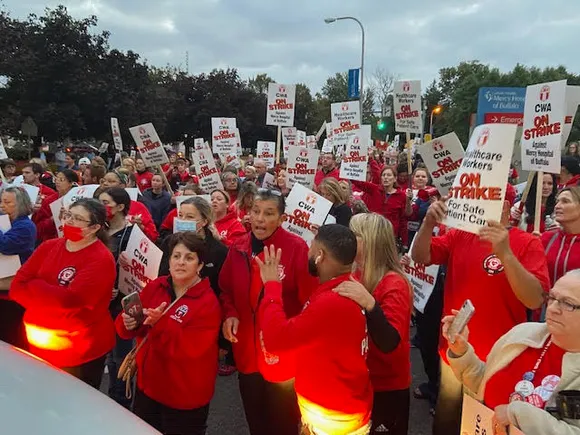
Last year, healthcare workers held multiple strikes, similar to the first year of the pandemic. Some of the major strikes included anearly 10-monthstrike by 800 nurses at a Massachusetts hospital, and a40-daystrike by 2,000 nurses in Buffalo, New York. Additionally, in December, a strike planned by tens of thousands of members atKaiser Permanentein Southern California was averted at the last minute. These disputes center on safer staffing measures, including nurse-to-patient ratios, stronger workplace safety protections, and better pay to recruit and retain staff.
With new COVID-19 variants and ongoing staff shortages giving workers more leverage, union actions may continue. Recently, healthcare unions, including National Nurses United, petitioned an appeals court to make permanent theemergency temporary standardthat the Occupational Safety and Health Administration (OSHA) issued for healthcare workers during the pandemic. The standard requires hospitals and other healthcare facilities to comply with measures regarding ventilation, physical barriers, and other protections aimed at reducing the spread of COVID-19. An analysis of labor agreements by Bloomberg Law found that many labor agreements between hospitals and unions representing healthcare workers will expire in the coming year, which could trigger more strikes if the parties cannot agree on new contract terms. The analysis noted that some major agreements expiring include one in August covering 19,000 workers at Kaiser Permanente in Central and Northern California, and one in October affecting 14,600 workers at the University of California.