
Five Major Trends in Medical Technology for 2025
In 2024, the medical technology industry made progress in areas such as pulsed field ablation and a rebound in mergers and acquisitions, but 2025 still faces challenges from China and uncertainties under the Trump administration. BTIG analyst Ryan Zimmerman noted that industry fundamentals remain stable and surgical demand is healthy. Based on interviews with multiple experts, this article summarizes five major trends: the competitive battle in robotic surgery between Intuitive Surgical and rivals, sustained strong M&A activity, potential trade war impacts, rapid penetration of PFA technology, and the first year of commercialization for renal denervation (RDN).
After a volatile and in many ways successful 2024, the medical technology industry has good reason to be optimistic about the future. Over the past year, the industry witnessed the rise of the emerging technology of pulsed field ablation (PFA), a rebound in M&A activity, robust procedure volumes, and a more normal economic environment, despite some challenges in international markets.
However, medical device companies will still need to navigate multiple obstacles in 2025, including ongoing economic challenges in China and uncertainty from the incoming Trump administration.
"There are still a lot of unknowns heading into 2025," BTIG analyst Ryan Zimmerman said in an interview. "But right now... procedure demand is healthy; the fundamentals for medtech entering the new year are stable; consumer sentiment is good; unemployment is low. Overall, conditions on the ground are quite good."
MedTech Dive spoke with several experts about important topics and trends to watch this year. Here are the top five medical technology trends to watch in 2025:
1. Intuitive vs. competitors
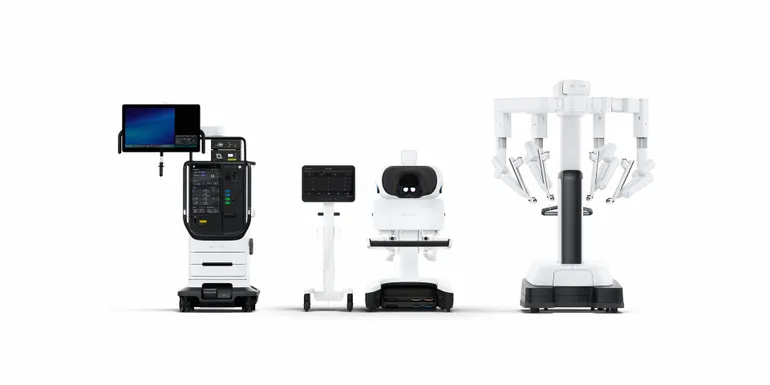
Intuitive Surgical's da Vinci 5 surgical robot was one of the biggest new product launches last year. Despite a limited rollout, Intuitive's installed base of soft-tissue surgical robots exceeded Wall Street expectations, adding more complexity to the long-standing question: Can competitors catch up to Intuitive?
"If you look at early da Vinci 5 demand... it's been remarkable," Zimmerman said. "To put it mildly."
Although Intuitive has maintained its dominance in soft-tissue surgery for nearly two decades, it now faces more competitors than ever before. Zimmerman said that five to ten years ago, only a handful of companies attended the annual meeting of the Society of Robotic Surgery; last year, more than 50 different robots were showcased on site, with over 50 more not exhibited.
Surgeon adoption and expansion into new surgical categories are also driving this growing market.
"Over time, all surgeries that can be done with robots will be done with robots," said RBC Capital Markets analyst Shagun Singh. "The market appetite is huge, and penetration is still only in the single digits."
Smaller competitors may take time to truly capture significant market share from Intuitive. Systems from large companies like Johnson & Johnson and Medtronic have not yet entered the U.S. market, suggesting that Intuitive's performance will remain the biggest story this year.
Intuitive's expectations for 2025 are not yet known, as the company does not forecast system installations. Singh said the company should transition to a full launch of da Vinci 5 later this year, adding momentum to an already highly anticipated release.
As new competitors mature and continue to enter, there may still be room for success under Intuitive's dominance. Zimmerman noted that different systems now cover a variety of surgical fields, from soft tissue to hard tissue, ophthalmology, and cardiac applications. He added that the current environment is not zero-sum; "it's not that you either beat Intuitive or lose to Intuitive."
Despite the increase in competitors, Intuitive's leading position may still hold. Singh said that even Johnson & Johnson, with its abundant resources and strong presence in surgical fields, may find it difficult to pose a substantial challenge to Intuitive.
"I've been following Intuitive for 20 years," Singh said. "I'm not worried about the competition."
2. Medtech spending remains strong
Medtech companies experienced a busy year of M&A last year, and that momentum has continued. Stryker announced this week it will acquire Inari Medical for nearly $5 billion, while Boston Scientific, one of the biggest buyers last year, said it will acquire the remaining shares of Bolt Medical for up to $664 million.
After deal volumes rebounded in 2024 from lows in the previous two years, the industry may see another busy M&A year. Zimmerman said last year's growth was partly due to lower valuations, which could also spur more spending this year.
"If interest rates continue to fall, debt costs decline, and valuations are reasonable, that's a good recipe for M&A," Zimmerman added.
After a busy M&A year in 2024, Truist Securities analysts said Boston Scientific could be one of the biggest buyers in 2025.
EY partner John Babitt said there could be some deals in the robotics space this year, as the field has significant growth potential and multiple sub-specialty treatment areas are receiving venture capital support. Babitt also highlighted structural heart and PFA as areas to watch.
Truist Securities analysts wrote in a December note to investors that they expect increased M&A activity in 2025, including larger acquisitions, and that lower interest rates and increased deal activity could also lead to more "portfolio pruning." The analysts also expect Stryker, Boston Scientific, Zimmer, and Medtronic to be the most active buyers.
M&A activity could also get a boost after President-elect Donald Trump takes office later this month. Experts told MedTech Dive last year that the Trump administration could be more favorable to deals compared to the Biden administration, whose sometimes lengthy review timelines may have discouraged companies from pursuing acquisitions.
3. Trade war may loom
The medical device industry is preparing for the Trump administration to affect its business in other ways. Since Trump won re-election in November and began nominating unconventional candidates for top federal health positions, device companies have been shrouded in uncertainty.
One key question is whether changes from the Trump administration will reach the medical device industry, as some of the industry's top issues are less prominent than those facing the pharmaceutical industry or healthcare providers. But that doesn't mean there won't be an impact, or that uncertainty alone won't force companies to adjust.
Tariffs and a potential trade war are key issues that could directly affect medtech companies. Trump has threatened to raise tariffs on China and impose tariffs on Mexico and Canada.
"We are very concerned about trade wars and geopolitics," Zimmerman said, adding that companies with significant exposure to China will be a key focus this year.
Zimmerman said a potential trade war with China would compound the country's slowing economic growth. "China has long been a growth engine for many medtech companies," he said.
According to Zimmerman, companies like GE HealthCare, Intuitive, and Staar Surgical are more sensitive to China's economic issues. He said trade challenges with Canada and Mexico could also affect the industry, as many device companies have manufacturing facilities in those two countries.
The change in administration at the White House could also lead to longer product approval times due to FDA staffing shortages, a problem seen during Trump's first term, Zimmerman said. FDA employees may leave because Robert F. Kennedy Jr. and Martin Makary have been selected to lead HHS and the FDA, as they differ significantly from previous leadership.
Outgoing FDA Commissioner Robert Califf recently warned in an interview with Stat News that "increased early retirements and a loss of top talent" could occur at the agency.
"This is something we are closely monitoring," Zimmerman said.
4. PFA success story continues
Last year, new pulsed field ablation (PFA) products received a great deal of attention and acclaim. The technology sparked intense product launches and market share battles among industry giants.
PFA is a new method for treating arrhythmias that is disrupting traditional therapies and generating significant revenue for companies. PFA treats atrial fibrillation by targeting heart tissue with non-thermal electrical energy, whereas radiofrequency ablation (RFA) uses heat, and cryoablation uses extremely cold temperatures.
Medtronic and Boston Scientific were the first two companies to launch PFA devices, followed by Johnson & Johnson's approval, Medtronic's second approval, and Boston Scientific's mapping technology authorization. In addition to product launches, companies released data on PFA technology throughout the year, including at the annual TCT conference.
"Every data release comes with lights, cameras, and action," Babitt said, noting that PFA will be one of the "most exciting" areas in medtech.
Medtronic and Boston Scientific reported strong physician adoption rates, and a recent Citi Research survey of electrophysiologists found that PFA procedure volumes will surpass RFA this year.
Singh noted that 2024 was only the first year for PFA, and the market will remain an important growth driver. She added that RBC will watch market share changes this year, but PFA is not a "share shift" story.
"This is not a mature market where you have to think about one side losing and the other winning. This is a highly underpenetrated market," Singh said. "I really encourage investors to think about how everyone can win in this space."
Boston Scientific's Farapulse PFA system could perform well again this year. Singh called Farapulse "definitely the go-to product." The company may also benefit from Johnson & Johnson's decision to pause the U.S. rollout of its Varipulse system due to safety concerns.
5. The year of RDN?
Several experts listed renal denervation (RDN) as a topic to watch in 2025. RDN is a new treatment for patients with hypertension who do not respond well to medication and lifestyle changes. The procedure helps lower blood pressure by reducing the activity of renal nerves in the kidneys.
Medtronic and Recor Medical, a small subsidiary of Otsuka Medical Devices, are the only two companies with FDA-approved devices on the market. During an FDA advisory committee review of the benefits and risks of both devices, there were questions about whether the devices would receive insurance coverage; ultimately, the committee voted in favor of Recor's product but not Medtronic's.
However, the Centers for Medicare & Medicaid Services (CMS) granted transitional pass-through payment coverage for both devices late last year, opening the door to what Medtronic has called a market exceeding $1 billion.
"This could really be the GLP-1 moment for medtech," Babitt said. "You're addressing the huge field of hypertension with a curative—arguably curative—solution. As this market develops, it will be a very interesting story."
While Babitt does not think renal denervation will become the PFA of 2025, he said that with reimbursement now in place, the market is ready to grow and could eventually become larger than PFA.
Singh agreed, saying that while there may not be a PFA-like year, the long-term opportunity is "enormous," potentially becoming a multi-billion dollar market.


