
Four Major Trends in Robotic Surgery for 2025: Intensified Competition and Market Expansion
After nearly 25 years of dominance in the robotic surgery field, Intuitive Surgical will face challenges from numerous new entrants in 2025. The full market release of the da Vinci 5 system, the accelerated catch-up by Medtronic and Johnson & Johnson, small companies targeting niche markets, and the penetration of orthopedic robots into ambulatory surgery centers have become the four key directions of industry focus this year.
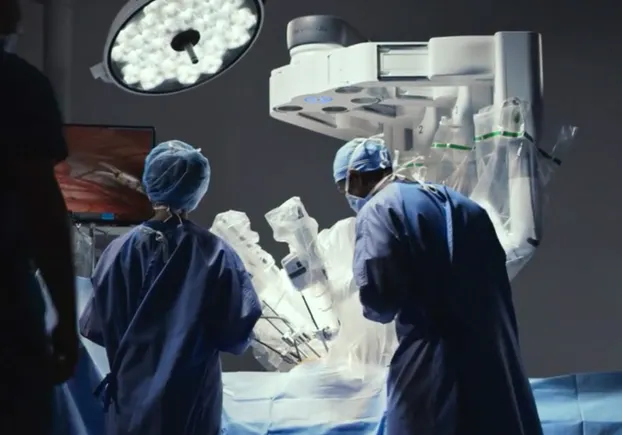
After decades of building the robotic surgery market, Intuitive Surgical will no longer have it all to itself starting in 2025. Since receiving its first FDA clearance about 25 years ago, the da Vinci robot has become widely used in a variety of laparoscopic soft tissue surgeries, covering cardiac, urologic, gynecologic, and general surgery fields.
Now, dozens of new entrants are poised to find breakthroughs in various segments of the surgical landscape. As Intuitive Surgical's da Vinci 5 system transitions from limited release to full commercial availability starting later this year, the surgical robotics pioneer will continue to drive the operating room's shift from open surgery to minimally invasive procedures. This mainstreaming trend has also drawn competitive responses from traditional surgical instrument suppliers such as Medtronic and Johnson & Johnson, both of which are now actively embracing robotic technology.
On last week's earnings call, Intuitive Surgical executives acknowledged that a new era of competition is coming. Chief Financial Officer Jamie Samath said, "Given that competitors are bringing robotic systems to market and seeking regulatory clearances in various regions, customers have increasing choices, and capital equipment sales cycles may lengthen as customers evaluate alternatives."
In orthopedics, robot-assisted implant surgery is expected to continue growing over the next year, with both Stryker and Zimmer Biomet planning to introduce shoulder applications for their platforms. Here are four major trends in surgical robotics that medical technology experts are watching this year:
1. Accelerated full launch of the da Vinci 5 system
The launch of Intuitive Surgical's da Vinci 5 system is still constrained by manufacturing capacity and supply chain build-out, but its performance has already exceeded analyst expectations. BTIG analyst Ryan Zimmerman said in an interview, "Four quarters since the launch of da Vinci 5, the start has been phenomenal. Adoption has been very strong, better than investor expectations, and we haven't even entered the full-scale launch phase yet."
According to Intuitive Surgical data, more than 2,500 surgeons have used the new system, completing over 40 procedure types cumulatively. Chief Executive Officer Gary Guthart said the company's top priority for 2025 is advancing the full launch of da Vinci 5. Customers will also receive regular hardware and software upgrades, beginning this year with digital capabilities supported by the system's significantly enhanced computing power.
The launch of da Vinci 5 is also Intuitive Surgical's preemptive move against key competitors like Medtronic. Medtronic's Hugo robot launched in Europe in 2021 and is now in use in 25 countries worldwide. Medtronic is now preparing to challenge the industry leader in the U.S. market. CEO Geoff Martha said this month that the company plans to submit a urology indication application to the FDA in the first quarter of 2025 and is enrolling patients in clinical trials to support future U.S. indications for hernia and gynecology.
Morningstar analyst Debbie Wang noted that Intuitive Surgical's massive installed base will make it difficult for any healthcare system to move away from its robots. Wang said, "Given clinicians' preference for the ease of use and design of da Vinci, I think any competitive threat, including Hugo, will find it difficult to truly hinder Intuitive Surgical and its da Vinci 5 rollout."
2. Medtronic aims for the second spot
Challenging Intuitive Surgical's dominance in robotics may be difficult, but analysts point out that preventing further loss of market share in surgical instruments is exactly what drives Medtronic and Johnson & Johnson to act. Zimmerman said, "Johnson & Johnson's and Medtronic's instrument businesses have been excellent cash cows for years. They were too slow to react, Intuitive Surgical grew too large to shake and surpassed them, and now both are scrambling to catch up."
Take Intuitive Surgical's stapling business, for example, which is now larger than Medtronic's and Johnson & Johnson's. Steve Bell, a medical technology startup advisor and former Chief Commercial Officer of CMR Surgical, noted that Intuitive Surgical is now the largest stapling company in the U.S. With pressure on their instrument businesses, Medtronic and Johnson & Johnson have had to respond. Bell said, "They have to do something, or in five to ten years there will be little left because everything is moving to robotics. So they have to try."
Bell believes Medtronic and eventually Johnson & Johnson will bring competition to Intuitive Surgical in robotic surgery, "but not by much." In November 2024, Johnson & Johnson received FDA approval to begin U.S. clinical trials for its Ottava surgical robot. Analysts noted in interviews that Johnson & Johnson's soft tissue robot launch has been delayed multiple times and is at least two years away from official introduction. Jeff Jonas, healthcare portfolio manager at Gabelli Funds, said, "They are so far behind schedule, which is unfortunate."
Bell predicts that ten years from now, Intuitive Surgical will still hold 70% of the surgical robotics market, with Medtronic and Johnson & Johnson each holding 10%, and the remaining 10% divided among smaller competitors. Medtronic has set a goal to become a "strong number two" in surgical robotics. Martha told investors at this month's J.P. Morgan Healthcare Conference, "Usually we aim for number one, but right now we're only targeting number two, and I think that's quite good in the near term."
3. Smaller developers target niche segments
Beyond the most well-known device makers in the medical technology industry, there are numerous smaller companies with surgical robotics ambitions, some of which may make their mark in the U.S. this year. BTIG's Zimmerman said, "The pace of new system launches is accelerating." These robot makers will seek differentiation through unique designs or by building advantages in specialties where Intuitive Surgical is less deeply involved. Zimmerman said, "These niche areas are where some companies succeed, and some are also competing on modular concepts—smaller and easier to move."
Companies that received FDA clearances over the past year include CMR Surgical, Distalmotion, Virtual Incision, Moon Surgical, Medical Microinstruments, and Procept Biorobotics. Recently, CMR received de novo authorization for its Versius robot in October 2024, with the initial indication for gallbladder removal surgery; Distalmotion received clearance for hernia repair the same month. Procept's system uses pressurized fluid to cut tissue and is used to treat benign prostatic hyperplasia.
Zimmerman said that although Intuitive Surgical has a significant lead in robotics, the global surgical market is far from saturated, which will benefit new entrants. "The opportunity is huge, and there is still much room for robotics to grow—that's clear." Bell cautioned that as many as 60 companies are vying for a share of the soft tissue surgical robotics market, and not all will succeed. "You'll see some small companies disappear. They can't all survive. They'll run out of money this year and then vanish."
4. Orthopedic robots accelerate penetration in ambulatory surgery centers
The increasing use of surgical robots in same-day procedures at ambulatory surgery centers (ASCs) is a trend boosting orthopedic implant makers such as Stryker and Zimmer Biomet. Morningstar's Wang said, "Orthopedic robots are racing to be installed in ASCs, and I expect this trend to continue in 2025 as outpatient major joint replacement surgery keeps growing."
This year, Stryker and Zimmer Biomet also plan to add shoulder capabilities to their surgical robots. Wang said, "Shoulder indications are the next important step. But I'm not sure robotic applications can help expand that market. Shoulder replacement is tricky because the joint involves a complex network of muscles and tendons. I don't know how robots and software will solve that problem."
In contrast, Wang believes spinal surgery could benefit from expanded robotic applications. "Given that the effectiveness of many spinal surgeries is at best moderate, there is potential for significant improvement. We do think Medtronic's Mazor and Globus's Excelsius can make a substantial difference."
