
From Patient Spontaneity to FDA Approval: How Tidepool Loop Paves a New Path for Diabetes Devices
After decades of research, artificial pancreas systems are finally moving toward commercialization, but existing hybrid closed-loop systems still limit patients' freedom to mix and match devices. The nonprofit organization Tidepool, based on the Loop app developed by the open-source DIY community, received FDA approval in January 2023, becoming the first patient-driven automated insulin delivery app to pass regulatory review. The app allows users to choose compatible glucose monitors and insulin pumps, although no third-party pumps have been approved yet. Tidepool's case may establish a regulatory precedent for future device-agnostic automated insulin delivery applications.
For decades, researchers and people with diabetes have worked to develop an artificial pancreas that can detect blood sugar levels and administer insulin as needed. These efforts have led to the commercialization of the first hybrid closed-loop systems—where continuous glucose monitors work in tandem with insulin pumps—in the multi-billion-dollar diabetes device market.
However, these systems still have limitations. For example, patients cannot choose which devices they want to pair, because the software that makes the two devices work together is currently integrated into the insulin pump.
So, while companies like Medtronic, Dexcom, and Tandem Diabetes Care each developed their own connected devices, people with diabetes and their families began building their own systems in a grassroots fashion, including an app called Loop that lets users pair devices of their choice to manage insulin delivery.
Building on this, the nonprofit organization Tidepool conducted a study of people using the DIY Loop app and submitted a version of the system to the U.S. Food and Drug Administration (FDA).

"Many of us, including my daughter, have been users of DIY Loop since around 2016," Tidepool CEO and founder Howard Look said in an interview. "We love it. It's a fantastic way to manage diabetes, and it really reduces the burden of day-to-day management of type 1 diabetes."
The resulting product, Tidepool Loop, received FDA approval in January 2023, offering users a new option to choose which pump or continuous glucose monitor to pair. But there's a catch: while some continuous glucose monitors can currently work with Tidepool, no insulin pump has yet been approved to work with a third-party controller.
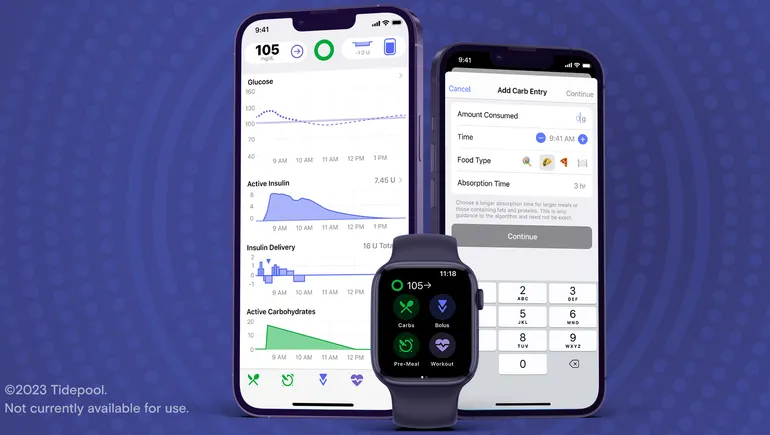
The app is designed to predict users' blood sugar levels to ensure they receive the correct dose of insulin. It also offers a feature that allows users to adjust mealtime insulin doses by entering an estimate of the carbohydrates they plan to consume.
Tidepool is smaller than other diabetes companies in the market. Abbott Laboratories, which hopes to turn its continuous glucose monitors into a $10 billion product over the next five years, had revenue of $43.65 billion in 2022; insulin pump maker Tandem, which plans to grow its installed user base to 1 million people by 2027, had revenue of $801.2 million. According to Tidepool's latest tax filing, in the 12 months ending June 30, 2021, Tidepool Loop had revenue of $8.06 million and year-end assets of $7.5 million.
Even so, the company represents a rare case of a patient-driven device going through the FDA regulatory process, and it could pave the way for future device-agnostic automated insulin delivery apps.
"Type 1 diabetes is especially a very individualized disease. Managing type 1 diabetes involves many factors, so being able to choose the components that best fit your daily management, I think, is very important and groundbreaking for the patient community," said Marjana Marinac, senior director of regulatory affairs at JDRF (formerly the Juvenile Diabetes Research Foundation), which focuses on type 1 diabetes.

DIY origins
The early DIY efforts grew out of the first DiabetesMine D-Data ExChange conference at Stanford University in 2013—a gathering of diabetes advocates and developers—where attendees (including Look) coined the hashtag #WeAreNotWaiting.
It all started with patients and parents figuring out how to download data from continuous glucose monitors to their phones, and one parent creating a device to connect his daughter's insulin pump to an iPhone. Later, a software engineer named Nate Rackyleft developed the original DIY Loop—an open-source app for automated insulin delivery.
"That's how it evolved. Different people came in and started taking on different parts," said Anna McCollister, an independent consultant on data use, access, and government affairs, who has type 1 diabetes. "I think it's the most compelling and exciting thing that has happened in digital health."
Look founded the nonprofit Tidepool in 2013 to create open-source tools to help people better manage diabetes. It started as a platform for patients to upload data from multiple devices, including continuous glucose monitors and insulin pumps, into one place.
In 2018, the nonprofit hired some of the people involved in developing Loop to build an FDA-approved version of the app.
The nonprofit also worked with members of the DIY community to recruit patients managing their diabetes with DIY Loop for a study. More than 1,000 people volunteered, providing ample data, and ultimately an application was submitted to the FDA in 2020. Tidepool worked with supporters including the Leona M. and Harry B. Helmsley Charitable Trust and JDRF, which together contributed $6 million to these efforts.
"The base code for Tidepool Loop was developed by the community and published as open source on GitHub, and then Howard and his team built on that base code and put regulatory controls and other measures in place," McCollister said. "In my view, it's a milestone, and it's significant. I think the FDA deserves credit for being willing to work with patient-driven efforts and nonprofits."
Tidepool Loop is currently approved for treating type 1 diabetes in people aged 6 and older. As for people with type 2 diabetes, Look hopes to expand the device's indications in the future.
What matters most to patients?
For Marinac, an important feature is compatibility with Apple products; it's the first insulin delivery app that can run on the Apple Watch.
"I currently use Apple devices. So when I need an additional device to control insulin delivery, I'll consider that," she said. "What can I use to reduce the number of items I need to carry around?"
McCollister said she would choose to use Loop over other existing systems.
"I feel much more comfortable with Loop's algorithm and its approach to error reporting," she said. "Almost everyone I know who was involved in this process is a patient, or a parent or spouse of a patient. So everyone involved has a personal stake," and a vested interest in quickly fixing bugs, she added.
Another important aspect is which devices Loop will be compatible with at launch.
Insulin pump makers Insulet and Medtronic were development partners but did not continue as launch partners. In a statement, the two companies said Medtronic has stopped developing an insulin pump system compatible with Tidepool Loop, while Insulet is currently focused on commercializing its new Omnipod 5 automated insulin delivery system. Tidepool Loop users will need to wait for a compatible pump to receive FDA approval to work with third-party controllers.
According to Tidepool, the only interoperable pump currently on the market is approved only to work with a controller made by the same manufacturer, although third-party interoperable pumps are in development.
The nonprofit is still working with continuous glucose monitor maker Dexcom and is in "active development" with a pump maker that supports alternate controller-enabled (ACE) pumps, which Look called "a company that people know and love." Because Tidepool's device is approved to allow third-party interoperability, "for us, once new devices are FDA-approved, it's easy to add new CGM and ACE pump devices without having to submit an application," he added.
Next steps
Look said the Tidepool Loop app will soon be available on the Apple App Store for iPhone users, but it will require a prescription. Doctors can prescribe it and set personalized starting parameters they deem appropriate for the patient, who will then receive a prescription code via email or text message to download the app.
The company has not yet set pricing and will work with device manufacturers to determine it, Look added.
"One of our missions is to make our technology as widely available as possible. That means keeping costs as low as possible," the CEO said.
According to Tidepool's financial statements, the organization had $2 million in cash and accounts receivable in 2022 and plans to use its service revenue—along with donations and grants—to fund its work.
"I believe the DIY community will always be vibrant and thriving," Look said. "(This) provides an option for those who don't want to build their own system, or who want the Loop experience but also want the peace of mind that comes with a doctor's prescription and FDA approval."